Thursday, July 19, 2007

Danny Boyle Interview

Here is my interview with Danny Boyle. Some side notes: I had 10 minutes with him. I was sandwiched between the ABC reporter and the CBS reporter. His microphone fell off during my intro so I did it a second time (not as well). His camera didn't stop rolling so it rolled out of tape with 15 seconds left. My camera rolled out on my last word. When I say I had 10 minutes, I had 10 minutes, the camera crew used 10-minute long tapes. We were probably rolling 45 seconds after I entered the room.

For a guy who is typically behind the scenes I did OK. Danny enjoyed it enough to send over an autographed poster. Let me know your thoughts. It's nine and a half minutes long. We discuss his film Sunshine, collaboration, sound design and how to get into the business. I previously embedded the clip here, but I think following the link is easier. It is 9 and a half minutes long.

PeterH


http://www.veoh.com/videoDetails.html?v=v823930TyTaa8Wj

Wednesday, July 18, 2007

Busy Busy

This post is mostly for my parents, who as they say, can't "get up on" the internet to get pictures I e-mail them. Here is hoping they can "get up on" Filmmaking 101.

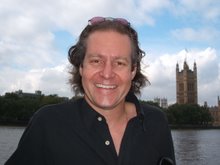
It has been a busy few days for the dumb filmmaker. On Saturday I went to the Chicago Film Festival tribute to Jacqueline Bisset. On Monday I went to a screening of Danny Boyle's new film Sunshine (That's me with a student and the director.) And yesterday I did a TV interview with Danny Boyle- me on camera yikes! Jim and I are editing it today, I will post it later this week. For those who don't know, Danny Boyle directed Trainspotting, 28 Days Later, Shallow Grave and others.


That's Jacqueline Bisset, looking good, and Roger Ebert and his wife, looking not so good. He is a trooper. Hard to tell here, perhaps, but he has been sick for a while with salivary gland cancer.


More Later.

PeterH

Monday, July 16, 2007

The Music Man

A dynamic sound track is critical to making a successful film. I argue that good sound design is perhaps more important than good looking pictures. If you have ever seen a film that is "thin" when it comes to sound, you know what I mean. Of course the most obvious part of the sound track is the music and for us it is one stop shopping with Eric Sproull at Earhole Studios. http://www.earholestudios.com/

I have known Eric since college. He played keyboards on a music video I made (I have pictures of him dressed in all sorts of garish costumes that I threaten to give to his kids) and we have been friends since. On more then one (five?) occasion(s) he has given us just the right bit of music to create the mood. Once he gave us some temp music that the client liked so much, we kept it. Other times he has created demo after demo for us looking for the right sound. When not bailing us out he does high end commercial jingles- check out his reel on the Earhole website.

Here are some facts that don't make his professional bio.

1) About 15 years ago he decided to go to law school at night. He did, passed the bar and until recently worked one day a week at the public defender's office in Evanston, IL.

2) He and his wife have two kids of their own and a bevy of foster children and their relatives. At any given time he has at least six people and as many animals living in their house.

3) He is a committed parent and supporter of the Waldorf Schools. http://www.awsna.org/

4) A year ago he moved his family to Ann Arbor, MI. There he has a goats, horses and an in-ground swimming pool. He has created a small recording studio there and comes to Chicago three days a week.

PeterH

Thursday, July 12, 2007

Assistant Director Extraordinaire

With apologies to Ali G. my main man when it comes to assistant directors is Normann (yes, three N's- that's how it's done Skokie-style) Pokorny. Normann is my friend, occasional golf partner, and regular member of the 7am omelet club at the local diner. He is also the person who answers all my (and many of my friends') computer questions, "Hey Norm what's a USB?"

Even if we weren't friends, Normann would still be our first call for a.d. He works on the BIG Chicago jobs, E.R., when it shoots here, many films- Stuart (Smalley) Saves his Family, Normal Life and TV series such as The Untouchables and Early Edition. When not busy on those type projects, he slums it and works with us.

Most assistant directors look to run an efficient show- time is money. Normann does too, but he is also always thinking about how to make the film better. While we have worked together often, my favorite time was on this little film for the Batesville Casket Company. I had written the script and was going to direct, but I just couldn't "see" the film in my mind. I think I was so wrapped up in the writing- I finished the last draft just a day before production began- that I was burned out. So, on a dreary Saturday before our Monday shoot Normann- on his own nickel- asked me if I wanted to go to our location and we talked through the shots. The time we spent together and with Jim, pre-visualizing the film was priceless. Normann saved the day for this dumb filmmaker.

For that I say to him, "respek." Thanks Norm.

PeterH

Wednesday, July 11, 2007

The Filter Factor

I had several good comments and questions on my "more collaboration" post about filtering out those bad suggestions cast or crew members might have. I am going to try to answer that issue here.

As I indicated earlier, I like to create an environment where cast and crew can feel comfortable sharing their ideas. I am open to anything but, I only take the ones I feel are good. To me it all starts with the culture we create on the set. Jim and I are very easy (I like to think) to work with. We aren't egomaniacs or pretentious (this improved greatly after I stopped wearing jodhpurs, a beret and carrying a riding crop) and we truly value everyone's efforts.

I think when new crew is hired they can take a quick read of the situation and know how to act appropriately. I also believe I have a pretty good filter for siphoning out bad ideas. It is not unlike teaching when students make comments- I take the Socratic approach and ask them a series of questions to get to an understanding of what they are thinking. So, if a p.a. suggests something crazy I will ask them why, and try to teach them a little about the bigger picture of what we are trying to accomplish. To me this helps create that collaborative atmosphere I so appreciate.

Finally, many suggestions from crew members come not to me directly, but via the assistant director. And the assistant director is what I am going to post about next.

PeterH

Tuesday, July 10, 2007

Video Assist

A big part of professional filmmaking- especially when clients are on the set- is the video assist set up. Video assist (invented by Jerry Lewis so he could be in the films he directed) taps into the optical system of your film camera and allows you to run a video feed to TV monitor or a series of monitors. On many larger shoots you create a video village, a little area just off the set often shrouded in black to cut down on the glare, for the clients and executives to watch what you are shooting. It is at the same time ridiculous- they could just look up and see it with their own eyes- and mandatory. Video assist is de rigeur.

When I first started I thought video assist was an indulgence. In fact I thought it was a sign of sloppiness. Once when asked if I wanted video assist I said , "No thank you I have an imagination." I quickly changed my mind when I had clients breathing down my neck. Not only can you see what you are shooting, live, but you can roll back the video assist tape and check what you just shot. My imagination is pretty good, but not that good. In addition it is a giant safety blanket for those trust-challenged clients, who really like to belt and suspender everything.

My biggest lesson about the benefits of video assist came from Jim's wife Kim. Before she was a nurse she worked in the film business as a video assist person. As such she spent a lot of time in the video village with the clients. The information she learned- not only about the shoot, but about office politics and agency worries was invaluable. Often Kim would come up to Jim or me and tell us something the client was worried about, BUT was afraid to tell us. Sometimes is was something mundane like there wasn't enough lime flavored bubbly water and other times it was pretty critical. Once Kim told me the client wanted me to consult with them more. After she told me I made it a point to check with them after every take and to spend more time with them.

It was a valuable lesson. Not only did I learn something about my own dealings with clients, but I learned that they don't always tell you what's on their mind. Thanks to Kim's eavesdropping we were able to make the client more comfortable and they called us often for more jobs.

PeterH

Monday, July 9, 2007

More Collaboration

It has been said that film directing is the last dictatorial job left in the world. That might be true. There are many directors famous for their tyranny and outrage and their good films. On my sets, however, I like to create an atmosphere where everyone feels free to contribute. I don’t pretend to have all the ideas and I will take any help offered, but at the same time I don’t turn around and poll the crew as to what we should do next.

We have worked with a gaffer named Tom Lewis many, many times. He always sort of intimidated me. He was a little gruff, until you got to know him. He has worked on thousands of projects over the years so he knows more than I ever will and he didn’t take fools lightly.

On the first job we did together I could tell he was a little skeptical. Here was this kid filmmaker with- in my projection- a million-dollar idea and a 50-dollar budget. I was asking for lots of lights- big, expensive and time consuming. One full day was going to be devoted just to readying the set, the next day to a pre-light, then finally a shoot that would only last 3-4 hours tops- a lot of work for a very short payoff.

Like any pro, Tom and his crew did the job and by the time we were shooting I think he realized I wasn’t quite as crazy as he first assumed. Over the hours I could see him understand more of my vision and his work was really helping me achieve it. As we are setting one of the last shots, and the shot that will conclude the film, Tom noticed something that escaped me and everyone else. As our lead walked off into the “sunset” it appeared as if the window sash was growing out of his head.

Tom, very quietly, said to me, “Why don’t we lower the camera (we were on a jib arm that could move up and down) as he walks away. It will change the perspective of the window sash.”

It was a great idea, one that didn’t really change the film at all, but an idea that came from Tom being present and in the moment and buying into my concept. It would have been easy for him to say nothing- it wouldn’t have mattered, and I would never have known the difference, but from that moment on we were able to forge a working relationship that lasted through dozens of projects.

PeterH